Queer Places:
Inglewood Park Cemetery, 720 East Florence Avenue, Inglewood, California, 90301-1482 USA
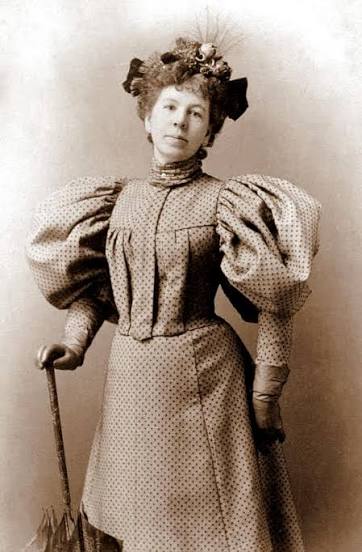 Clara Margaret Shortridge Foltz (July 16, 1849 - September 2, 1934) was a trailblazing American attorney, suffragist, and legal reformer. Best known as the first female lawyer on
the West Coast and the pioneering mind behind the public defender system, she spent over five decades breaking legal and social barriers for women and marginalized
individuals.
Clara Margaret Shortridge Foltz (July 16, 1849 - September 2, 1934) was a trailblazing American attorney, suffragist, and legal reformer. Best known as the first female lawyer on
the West Coast and the pioneering mind behind the public defender system, she spent over five decades breaking legal and social barriers for women and marginalized
individuals.
She was born in Indiana in 1849. In 1878, when California law restricted bar admission exclusively to white males, Foltz drafted and successfully lobbied for the
"Woman Lawyer Bill," changing the language to "any citizen". In September 1878, she became the first woman admitted to the California Bar.
Barred from attending Hastings College of the Law due to her gender, in 18979 Foltz co-authored an amendment to the California Constitution guaranteeing that no person
could be disqualified from any lawful business or profession on account of sex. She then successfully sued Hastings (Foltz v. Hoge) to force them to admit women.
At the Chicago World’s Fair in 1893, Foltz presented her radical concept that indigent criminal defendants deserve free, qualified legal representation provided by the
state—a model that laid the foundation for the public defender system across the United States.
Foltz was a key strategist for California’s 1911 suffrage movement, securing the vote for women state-wide and later publishing The New American Woman.
Relocating to Los Angeles after the 1906 San Francisco earthquake, she served as L.A. County's first female deputy district attorney in 1911.
Throughout her career, Foltz frequently represented impoverished, vulnerable, and socially marginalized clients who lacked access to fair representation. This work
connected her directly to early trans and gender-nonconforming history in Southern California.
In September 1915, Eugene De Forest—a trans-masculine/gender-nonconforming individual who lived and presented as a man—was
preparing to marry a widow named Mrs. Durress in Los Angeles. Shortly before the wedding, someone outed De Forest to local authorities. Police arrested him under
Los Angeles municipal cross-dressing ordinances, which criminalized wearing clothing associated with a gender other than one's assigned sex at birth.
Clara Shortridge Foltz stepped in as De Forest's defense attorney. Relying on her long-standing commitment to individual rights and equal protection under the law,
Foltz successfully challenged the charges, leading the court to drop all municipal charges against De Forest.
Although the legal case was won, the intense media sensation surrounding the arrest destroyed De Forest's upcoming marriage, as Mrs. Durress broke off the engagement
due to public scrutiny. Nevertheless, Foltz’s representation stands as an early 20th-century instance of a high-profile civil rights attorney defending a
gender-nonconforming individual against discriminatory sumptuary and cross-dressing laws.
References:
Other references:
- https://en.wikipedia.org/wiki/Clara_Shortridge_Foltz
- https://wlh.law.stanford.edu/wp-content/uploads/2010/10/AmNatBiogentry.pdf
- https://www.britannica.com/biography/Clara-Shortridge-Foltz
Support this project
This website is a passion project researched, developed, and funded entirely by me. If you find the content valuable and would like to help support the ongoing research and hosting costs, any contribution is deeply appreciated.
Thank you for keeping this independent resource alive!
My books on Amazon: Elisa Rolle's books
BACK TO HOME PAGE
